May 15, 2018

Easter 2018 at the Ball Park

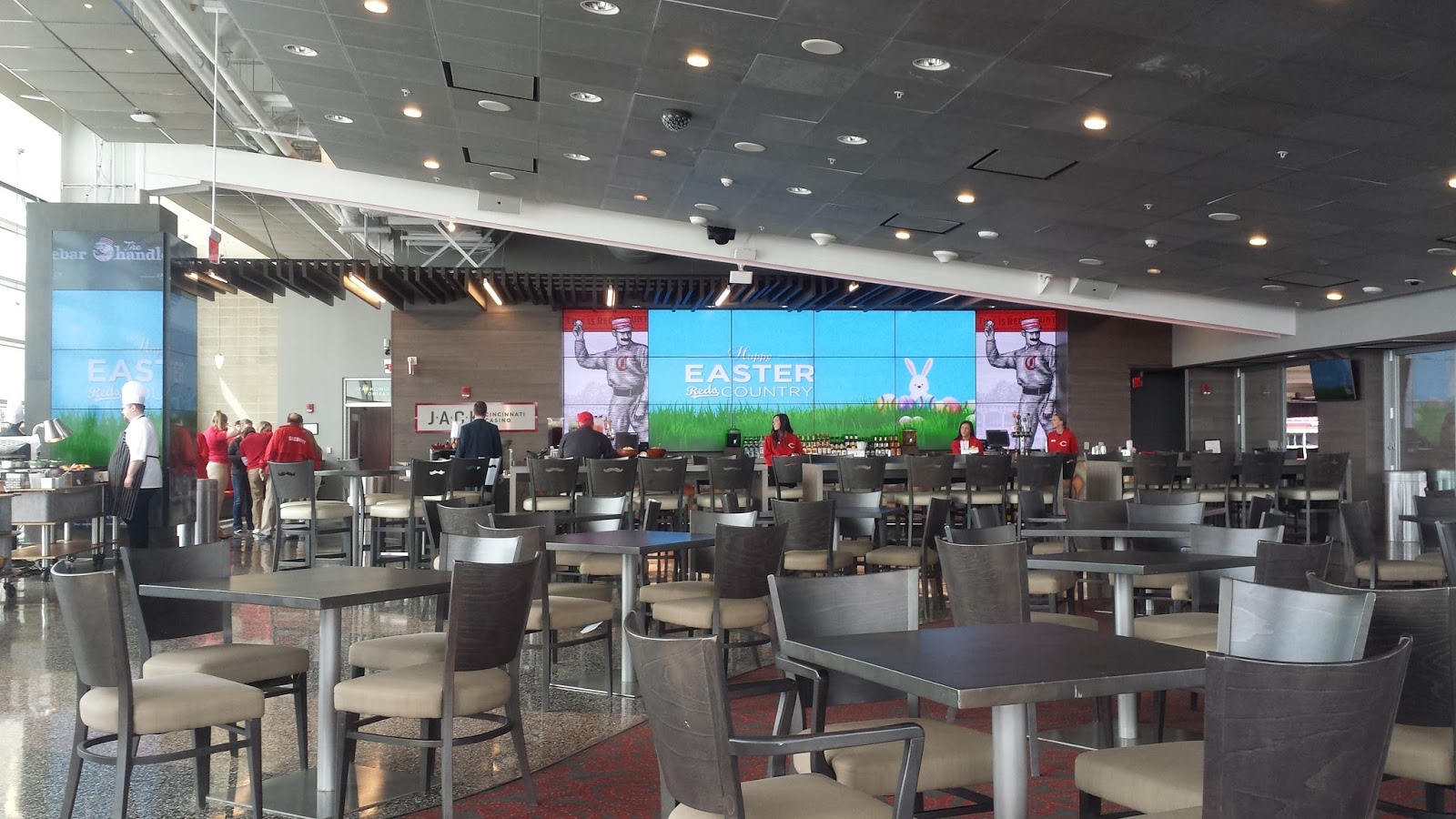
With Lou and his family away on a family road trip throughout the picturesque American southwest, that left me to my own devices for the Easter holiday.   Robert (he let's me call him "Bob") Castellini, in all his wise beneficence, included as a part of my Cincinnati Reds season ticket package two tickets to that Easter Sunday ballgame.  The weather conditions were a bit brisk that afternoon - because April 2018 in Ohio was still being throttled by Old Man Winter - so I treated My Dear Elderly Mother to a day in The Handlebar.


All-you-can-shovel food.  A selection of complimentary soft drinks, tea and coffee.  All the desserts your dentist will later profit from.  And, for those so inclined, vouchers for up to six free alcoholic drinks!  All for one (not so) low low price!  Make no mistake; if you plan to arrive an hour or more before the first pitch, if you have a sizable appetite, if you can swill copious quantities of alcohol over a 3-hour period, and if you prefer not to be subjected to the elements then The Handlebar is worth the heavy price tag.

Surprisingly, we had The Handlebar to ourselves.  No joke, we were joined by a young couple and later a family of four with two rambunctious children drifted in and out for brief periods.  Otherwise, The Handlebar was almost like our own personal luxury suite.  Sweet!


Aside from the friendly and helpful staff on hand, there was one other notable person in The Handlebar that Easter Sunday:


You never know who you'll bump into at the ballpark and on Easter Sunday Cincinnati Reds legend Tom Browning aka "Mr Perfect" bumped into me.  For about 10 minutes before the first pitch we hung out at the bar, talkin' baseball.  I asked Mr Perfect whether strike three is really the hardest strike to throw (with Homie's Opening Day pitching line in the back of my mind).  The answer was "Yes, and it also depends upon who is the umpire calling balls and strikes."  I axed Tom about young pitchers and whether they rolled into Rookie Ball with pitching mechanics that were already pretty close to Big League ready or whether they required a lot of work from their pitching coaches (with Reds top prospect Hunter Greene in mind).  Browning said generally the pitching mechanics of young prospects in the system are fairly well formed.  I asked Mr Perfect about pitching at old Mile High Stadium in Denver and we talked about some of his teammates from long ago;  Lloyd McClendon, Randy St. Clair, Mario Soto.

Brunches with Browning is a regularly scheduled event for Sunday home games at GABP.  $55 per person (not including the price of a game ticket).

The Handlebar offers expansive views of the ballpark and the riverfront:


The Ohio River was high, wide and mighty on Easter Sunday.

Held over for Easter from an Opening Day appearance was one of the world famous Budweiser Clydesdales.


This news just in;  That's a large horse!

My Dear Elderly Mother is loathe to be photographed, so I had to be sneaky about it.


Befitting "The Year Without A Spring," the next day it snowed in Reds Country.  Again.....


.....and the following day, a chilly rain washed away the snow on another damp, dark, cloudy day more appropriate for late November than April:


This was the dreary scene (above) that Tuesday morning in Hamilton, OH along the banks of the Great Miami River.

Roll the credits!

Derby 144 Epilogue

A record amount of rain fell on Derby Day at Churchill Downs this year:


Fun Fact;  Exterminator raced and won at old Latonia Raceway in Latonia, KY on the site, today, of Turfway Park in a prep race for the 44th running of the Kentucky Derby (1918).  In that year's Run for the Roses Exterminator finished first in a field of eight in just under 2 minutes 11 seconds on a track rated as "Muddy" (no surprise, right?) and paid $61.20 to win.

Not-so-fun Fact;  Many years ago I bid unsuccessfully on the silver julep cup awarded to the owners of Exterminator for winning that Latonia prep race.

Records for wagering on both the Derby itself and for Derby Day in its entirety were set this year:


Southwest Ohio, also known as God's Country, continues to be among the strongest television markets for the Kentucky Derby:


Way to go, Cincinnati and Dayton!

There were no 6-of-6 winning tickets for the Derby Day Pick Six.  Learning of such, a handicapper's mind immediately seizes upon one compound word; Carryover!

Following the teeming mass of humanity that descends upon Churchill Downs each year for Oaks and Derby Days and litters the premises with race programs, Daily Racing Forms, losing tickets, a not-insignificant number of winning tickets, hot dog wrappers, paper cups, dashed hopes and crippled dreams, the Twin Spires goes dark for a few days to put the place back into running order.  Thus, it would not be until the following Thursday that live racing would return to Louisville, KY and bring with it a Pick Six carryover of $770,000.00.  Expecting considerably more greenbacks to flood into the pool, I made like noted horse racing enthusiast Peter Edward Rose and dove in headfirst.  

The Thursday race card was filled with vastly less-accomplished thoroughbreds than inhabited Churchill Downs the previous week.


Using a common pejorative for such races and fields, "cheap races/horses."  Implied in those derogatives is the expectation of less predictability of outcomes among horses proven to be inconsistent competitors exhibiting poor results.  Even so, the Pick Six pool - bouyed by the three-quarter million dollar Derby Day carryover - ballooned to nearly $2 million dollars.  Horse players all around the globe aimed to take their shot.

The Derby Day Pick Six was set as a $2 minimum wager.  On Thursday, the minimum wager for the Pick Six was set at $0.20.  Accordingly, I loaded up my ticket with more combinations than typically would be financially practical.


As you can see, I had 3 winners, a second, a third and an also-ran that amounted to a payout of nothing.  

There were two dozen winning tickets each of which paid $81,891.72.

Roll the credits!

May 7, 2018

Kentucky Derby 2018; The Narrow Margin

For the TL;DR crowd, here is the summary;  I did not bet on the winner of the 144th running of the Kentucky Derby and I did not walk away from the racino with heavier pockets than when I entered 10 hours earlier that same day.  I did cash 8 winning tickets on the day.


The upside is that I have for the IRS a deep stack of un-cashed tickets with which I may offset any horse race wagering windfall I receive later this year.

The Old Master of the Turf is less inclined these days to travel to Keeneland for the Blue Grass Stakes, or for any race day at Keeneland, and so it has now been a few years since we last took off a day of work on a Saturday to watch in person a key prep race for the Derby.  Add to that the exhaustive workload of the busiest-ever January-April at TDS, Inc.... and the start of Reds baseball this season.... and I didn't have the free time to devote to the monitoring of everything related to the Kentucky Derby this year.  And so when The Old Master of the Turf met with me for doughnuts and coffee at Timmy Ho's this past Thursday morning it was my first opportunity to look at racing material - in this case race day programs for Friday's Kentucky Oaks and Saturday's Kentucky Derby - and to discuss in depth the subject with anyone.


I blew off work Friday afternoon to watch live coverage of Oaks Day on NBCSN and to handicap.  I didn't get my hands on my favored Daily Racing Form so I had to contend with whatever limited data was to be found in the thin Derby Day program.  In recent years I have shifted the focus of my wagering to playing the rolling Pick Three, the baby brother to the original Pick Six and the Pick Four (also a relatively recent development in the centuries-old saga of horse race wagering).  Of course there would be Win/Place wagers, some Exacta and Trifecta Boxes.   With $1-minimum Superfecta Boxes I would do my best to resist the siren song of monster-sized Superfecta payouts requiring IRS involvement before getting paid.

When you roll with The Old Master of the Turf, you arrive at the race track early.  EARLY.  At Mr B's direction we parked on the casino side of Miami Valley Gaming.


I suppose the casino was actually open for business at 9:30am.  After all, the lights were on.  The a/c was cranked up.  And..... it's a casino.  Aren't casinos open 24 hours a day?  At any rate, aside from me and The Old Master of the Turf, the casino appeared to be utterly devoid of human life.  As was, for that matter, the track side grandstand at MVG where Mr B reserved a table for 8:


The TV monitors which soon would be simulcasting racing from tracks all across the country were at that early hour all dark.

With the spare time I mapped out my wagering strategy.  In particular, which horses to include in my modest Pick Six (Races 7-12), the three different Pick Four's (Races 2-5, 5-8 and 9-12) and the rolling Pick Three's (rolling because a new Pick Three starts with every race until near the end of the race card when there are no longer three upcoming races to include).

After the first three races on the Derby Day under card, not one of my nine different wagers proved to be a winner.  In the first race I had an Exacta Box that finished 1st & 4th.  In the second race a Superfecta Box that finished 1st & 4th & well-up-the-track & M.I.A. In the third race an Exacta Box that wound up 3rd & long.


I turned the program page to Race 4 already $59.00 down, inked my wagers onto the bottom of the program page and went off to place my bets.  My Trifecta Box ran 1st & 2nd & not-good-enough but I hit the back end of a modest Win/Place wager.  

Eureka!

This slight improvement in fortunes spurred me to three consecutive races in which I had a Win or Win/Place wager on the eventual winner:


There were other losing tickets in these same three races which offset some of my gains, but the net result had me back to within $16.00 of breaking even halfway through the race day and thus giving me the bankroll reserves to attack the remainder of the race card.

You will note in the series of three successive photographs immediately above that my Race 6 winner is represented not by my cashable Win ticket but rather my winning Pick Three.  That little beauty cost me $6.00 and returned $43.00.  You can see the appeal of wagering on a Pick Three.  On Derby Day, the Pick Three's paid:

$47.70
$101.80
$103.15
$43.00 [mine]
$54.35
$126.15
$250.45
$2,917.85
$672.00
$3,274.55

As the day wore on it became more difficult to pick winners.  This fact may be discerned from the progression of Pick Three payouts.  To hit a sizable Pick Three like the $2,900.00 payout (above) you'd have to pick some long shots like the 39-1 winner in that race.  Which I did.  On my ticket (Race 8 Pick Three, below) I included the #3 horse which went off at odds of 49-1 and finished second. [I did collect the back half of a Win/Place wager on that 49-1 long shot, named New York Central - the railroad my grandfather worked for.  It paid $27.80 for a $2 bet.  This proved the be the last of the 8 tickets I cashed on Derby Day.]

I played ten Pick Three's on Derby Day, from races 1 through 10.  I cashed just the one, pictured above.  The narrow margin that separated me from being down on the day and being up on the day... or driving home in a Brink's Truck... is revealed by the nine losing Pick Three tickets.  Here they are:


My Pick Three tickets from Races 1 through 7, excluding the winning Pick Three from Race 4, all.... all.... had two-of-three correct selections [highlighted in orange].  Three of those six losing Pick Three tickets would see my errant selection finish, agonizingly, in second place.  A fourth of those six losing Pick Three tickets would see my incorrect selection finish in third place.

Had any one of those 3 second-place horses wound up in the winner's circle (or the third-place horse) I would have walked away from the track even for the day.   Had two or three of those hard-charging thoroughbreds been just a few strides more fleet, my narrow margin of misfortune would have turned into a plain old fortune.

Razor-thin.  That was the difference in my Derby Day.  As the old saying goes, That's horse racing.

Additionally, I played all three Pick Four's and one of them - begun with Race 5 (see below) - was "live" through the first three races (highlighted again in orange) but the ticket ran aground for the final leg.


And while, as a whole, my Pick Four wagers were not quite the equal to my Pick Three's, you will observe my handwritten notes (on the tickets) that my Race 2 Pick Four included a first- and second-place finisher and the Race 9 Pick Four had a winner and two seconds. 

My Pick Six started strong but then immediately was sunk:


The Old Master of the Turf acquitted himself well enough to be satisfied with his own efforts:


I call this one "Mr B and the Green Salad of Salvation."  And get a load of the random dude wearing a Derby Day sombrero at the next table. 

The time between races expands, seemingly exponentially, as the Derby Day race card wears on.  This is primarily as a function of accommodating the lengthening lines at Churchill Downs betting windows.  In truth, that phenomenon of lengthening lines at betting windows occurs at every simulcast site around the country.   What else is a horse player to do with the excess time but check out the other race tracks to see what might be going on elsewhere.  Maybe there's a jockey you like at Gulfstream Park and he is about to enter the starting gate riding a long shot.  Perhaps Alyssa Ali is reporting live from the paddock at Arlington Park and you find her irresistible.  Or the betting favorite in the upcoming race at Belmont Park has bloodlines tracing your favorite race horses/sires:


Ghostzapper?  Holy Bull?  I couldn't get to the betting window fast enough!  The filly Holy Helena won.  This Belmont winner was the only non-Churchill Downs wager I placed on Derby Day 

Two of Mr B's cosa nostra of old-time horse players joined us at our table.  They were fully, I say fully, engaged.


One makes book on his untraceable mobile phone while the other [names withheld to protect the innocent], holding a sheet of wagers as long as a necktie, reacts with some warm feeling toward events unfolding on the turf.

With that, we have now reached that portion of my annual Derby Day recap where - once again - I immodestly remind my loyal subscribers of just how well my handicapping measures up against the best expert analysis that the Daily Racing Form has to offer.  First the usual stipulation that this is not a back-handed compliment of the DRF.  I think the DRF staff of handicappers, along with Steve Haskin at The Blood-Horse and Randy Moss on NBC, uniformly are very good at what they do.  But even when performing at their very best they do not exceed my own ability to handicap a race card.  For Derby Day, the DRF assigned just three of their analysts - Byron King, Kenny Peck and Marty McGee - to give their selections for the full Derby Day race card.  The race card that day included two minor races after the 144th running of the Derby.  I didn't handicap those races, as I never do, because me and The Old Master of the Turf would be well on our way home long before those races went off.  Therefore, we evaluate races 1 through 12 (Race 12 was the Kentucky Derby):


The three horses I correctly picked to win, addressed well above, are highlighted here in orange; McCracken, American Gal and Proctor's Ledge in Races 5-7.  

Byron King correctly identified one winner on the day (circled in blue ink; Big Gray Rocket in Race 2), Kenny Peck also identified correctly one winner (McCracken, Race 5) and Marty McGee correctly selected three winners (American Gal in Race 5, Proctor's ledge in Race 6 and Yoshida in Race 11).

One of those three DRF analysts - Byron King - selected for the Derby the same horse as did I, Bolt D'Oro.   The DRF "Timeform Analysis" also liked my horse:


Steve Haskin from The Blood-Horse ranked Bolt D'Oro 4th for his final "Derby Dozen" column, published Derby week:


Neither of the other two Churchill Downs analysts selected my horse nor the eventual winner, Justify, among their top three preferences.  The DRF "Timeform Analysis" lays out the case most of us subscribed to for taking a stand against Justify:


Plus, there was the oldest "curse" in American sports - The Curse of Apollo.  Justify being the first horse to win the Derby without having raced as a two-year old in nearly 140 years has less to do with inferred superstar status than it does changes in modern training practices.  Once upon a time, horses raced - often - at the age of 2:


Steve Haskin ranked Justify #3, just ahead of Bolt D'Oro on his "Derby Dozen:"


Perhaps the biggest winner on Derby Day was the legacy of Ghostzapper as a sire.  If you review the photographs of my three successive Churchill Downs winners, well above, you will see that two of those winners were sired by Ghostzapper as was my lone Belmont wager/winner and the third of my Churchill Downs winners has Ghostzapper as dam sire (the father of the horse's mudder... I mean mother).  As for Justify, the winner of the 144th running of the Kentucky Derby:


That's right!  Ghostzapper, dam sire.

Here is your final order of finish, in case you lost sight of your mud-drenched Derby horse (as did Mr B):


And your menu of Derby payouts:


Note the $770,000.00 Pick Six carryover.  This Thursday.  Churchill Downs.  I'm just sayin'.

Roll the credits!

May 3, 2018

Opening Day 2018 Goes to Hell. Or Not. Just Don't Ask The Pope.

For the 2018 Major League Baseball season, Commissioner Rob Manfred made the long-overdue decision to end the recent policy of having two teams - usually excluding the Cincinnati Reds, the team that traditionally played the first game of the season - start the championship season on a Sunday night telecast of ESPN.  For 2018, all teams would begin play on the same day!

Yay! 

And then the rains came.


The day before Opening Day, my close personal friend Robert (he lets me call him "Bob") Castellini postponed Opening Day by 24 hours from Thursday afternoon March 29th to Good Friday March 30th.  There was some speculation on local talk radio as to whether Good Friday would then be adjusted to Saturday and if Easter Sunday would be observed on Monday.  It was not.  Talk radio echoed with callers exulting the decision, almost unanimously asserting that Friday afternoon would be a better day for Cincinnati to throw its annual Opening Day celebration of the American Pastime.

Except for Lou, who had a ticket for Thursday's Opening Day game and would be one-third of the way to Arizona on a family Spring Break road trip on Friday afternoon.

Thanks Obama! Bob!


Fortunately, I was joined in my field-level seats on Opening Day by Mr & Mrs Incomparable Joe Wilhelm [not photographed].   While Joe & Mary were outside the ballpark chilling at the Reds' pregame "Block Party," I was hanging out with my close personal friend and Reds broadcaster emeritus George Grande:


The weather forecast for the postponed Opening Day called for a mix of clouds and sun (it turned out to be mostly cloudy) and a high temperature in the upper 40s.  I layered up, busted out the shades and arrived 2 hours before the first pitch.


My seat was 7 rows from the field, down the left field line, and was bombarded with baseballs during the visiting Washington Nationals' batting practice.  Shortly before game time the two starting pitchers got loose in the outfield:


Three-time Cy Young Award winner Max Scherzer (at left, above) of the Expos Nationals and the Reds Homer Bailey (at right, above), the author of two no-hitters, were that day's starting pitchers.  

20 minutes before the first pitch, the stands were approximately 50% empty or, if you prefer, approximately 50% full.


Soon after we all stood for the National Anthem.....


.....and cheered mightily when two F-16s roared just overhead for the pregame flyover!


Eventually, sometime around the 5th inning, the sun made a brief appearance:


Through the 6th inning, Mad Max and Homie battled to a 1-0 score, advantage Expos Nationals.  The game was riveting as was watching the climbing "Split the Pot" tally:


I was not a winner that day.  And neither were the Reds.  My untested but presumed lucky baseball sox (a Christmas gift) proved to be unlucky.


On the drive home after the game, having been ditched in the 8th inning by the Incomparables, I stopped at Frisch's for some Good Friday/Lenten-approved fish and chips.


Although no less an authority than the Pope himself made news on Opening Day calling into some question the point of sacrifice and saintly living for Catholics:


One guy in particular was bent vociferously out of shape by this startling news from the Bishop of Rome: 


Hell or no hell, I was having my favorite dessert found at any restaurant:


MMMmmm!  Frisch's hot fudge cake.  It's fiendishly delicious.

While siting there in my booth, with nobody to talk to... because I'd been ditched by Joe & Mary, I dove deep into the Opening Day box score and found the crucial statistics which determined the eventual outcome of the game and which also reveal the differences between a great pitcher like Mad Max and a merely good pitcher like Homie.


Both Mad Max and Homie pitched 6 innings before getting the hook.  Mad Max gave up 5 hits, Homie 4 hits.  Scherzer walked 1, Bailey 3.  Mad Max threw 100 pitches, Homie hurled 104 pitches.  Mad Max threw 67 strikes, Homie matched him with 67 strikes.

So far, very comparable.  And, in fact, the score stood at 1-0 when both pitchers departed the game.

Note, however, that Scherzer recorded 10 strike outs, Bailey struck out just 3 batters.  

Of Homie's 67 strikes thrown, 1 out of every 22 [22.3 to be precise] was strike three whereas for Mad Max 1 out of every 7 [in fact, 6.7] of his 67 strikes thrown were strike three.  Where Scherzer is putting away batters with strike three at a much greater rate, Bailey is getting to strike two but is unable himself to put away batters.  For Homie, that means - generally - more batters facing him are walking or putting the ball in play, getting on base via an error or fielders' choice, perhaps advancing a runner on a sacrifice or driving in runs with hits or home runs.

One pitcher is a multiple Cy Young Award winner, the other will never win a Cy Young Award. 


I found peaceful solace in the Reds Opening Day loss when being serenaded under a full moon by Dire Straits on my drive back to The Ranch:


Roll the credits!

Search This Blog

Total Pageviews